

Dyeing & Fermentation
Dyeing with botanical pigments is the most labor-intensive stage in producing a carpet using ancient technologies. The dyeing process can last for several months. Dyeing techniques may be divided into two principal groups: boiling-vat dyeing and cold dyeing, in which the wool is colored without boiling.
A crucial prerequisite for successful dyeing in antiquity was a properly executed fermentation process. This technology enables the pigment to penetrate the wool fiber, reaching the cortex layer beneath the protective scales of the cuticle.
The interscale space of the cuticle is filled with a lipid-based secretion, and only after its removal does the cortex become accessible to the mordant. Without this step, the dye would rapidly fade. To increase the permeability of the cuticle, artisans used fermentation with lactic-acid–producing molds, which break down the lipid secretion within approximately three weeks. Improper fermentation carries a high risk of fiber degradation.
A key event that allowed researchers to understand how the earliest carpets might have appeared was the discovery of ancient felt and knotted-pile carpets in the Pazyryk burials of the Altai Mountains. These carpets, now preserved in the State Hermitage Museum, are more than 2,000 years old. In 1949, during the final year of excavation at the site, Sergei I. Rudenko uncovered the Fifth Pazyryk Kurgan. In the center of the kurgan, a looters’ shaft had allowed rainwater to infiltrate the chamber, creating a unique microclimate. The water froze and remained permanently in the form of ice, preserving organic materials that would otherwise have decayed. Among the most important discoveries in the Fifth Pazyryk Kurgan is a remarkably well-preserved knotted-pile carpet.
In March 2021, Scientific Reports published a study reporting the results of X-ray fluorescence (XRF) analysis of pile fibers from the Pazyryk carpet (https://www.nature.com/articles/s41598-021-84747-z). The research was conducted by a group of scholars from Germany, Russia, and Switzerland, including Dr. Andreas Späth of Friedrich–Alexander University Erlangen–Nuremberg.
According to the authors, the Pazyryk carpet is “a unique representative of ancient Central Asian cultural heritage” and was produced using wool that had undergone fermentation prior to dyeing. Analysis of the pile fibers revealed the presence of several metals, with aluminum predominating. This finding suggests that potassium aluminum sulfate (KAl(SO₄)₂) may have been used as a mordant.
The use of madder (Rubia tinctorum) in Pazyryk culture was demonstrated through chromatography and UV spectroscopy of the extracted pigment. The dyeing characteristics described in the Scientific Reports article correspond closely to the techniques historically used by Turkmen weavers.
Dr. Andreas Späth kindly agreed to perform an analytical study of woolen yarns prepared and dyed by us using traditional Turkmen methods. Results from the first stage of analysis (SEM images presented below) confirm that certain ancient fermentation techniques employed by Turkmen weavers produced lifted cuticular layers, indicating pigment penetration into the fiber interior. Thus, the research demonstrates that ancient Turkmen artisans fermented wool, used potassium aluminum sulfate as a mordant, and dyed with madder, in the same manner as the craftsmen who created the Pazyryk carpet.
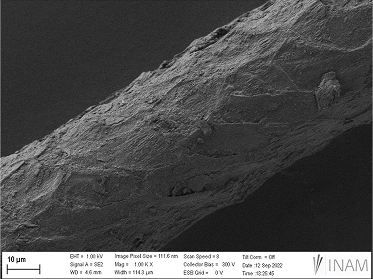
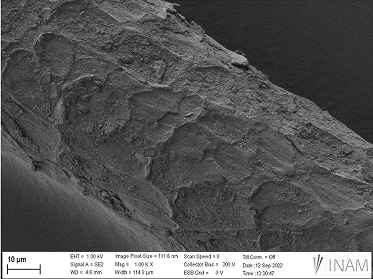
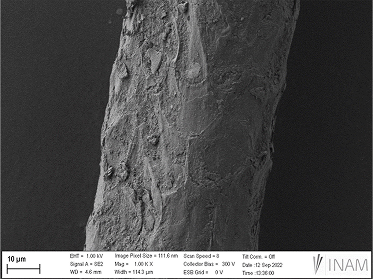
OG 4 - yarn 40 days fermented with wheat // subsequently boiled with KAI(SO4)2 // cold dyeing bath
Clear scale abduction, strong effect.
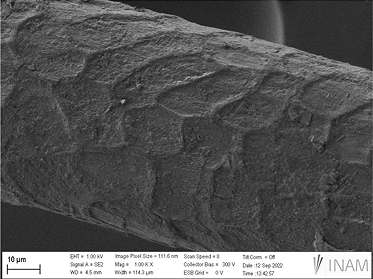
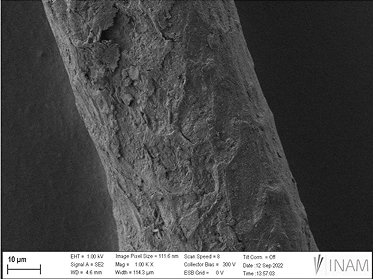
OG 4a - yarn 40 days fermented with wheat // subsequently boiled with KAI(SO4)2 // 2x cold dyeing bath
Similar to OG4


