

El Darak does not create a new story — El Darak continues an eternal one.
When regarded as a guardian of collective memory — a vessel of knowledge and a witness to epochs so distant that they recede into the horizon of antiquity, yet preserved within the woven arts to this very day — the Turkmen carpet reveals that its geometry can speak far more eloquently than it appears at first glance. As it traveled along the trade routes of the Great Silk Road, the carpet served as a messenger of time, carrying into distant lands not only material beauty, but also a spiritual lexicon that expressed a philosophy of harmony and cosmic order. It was never perceived merely as a decorative object.
Rather, it was understood as a bearer of the intelligence of the origin — a witness to the world’s cosmogonic beginning. This singular quality allowed Turkmen carpets to emerge as one of the most expressive artistic phenomena, securing for them the status of an authentic voice in the history of the woven arts.
Today, this legacy is preserved and carried forward by El Darak.
From the Neolithic Period to the Present
Archaeological Evidence
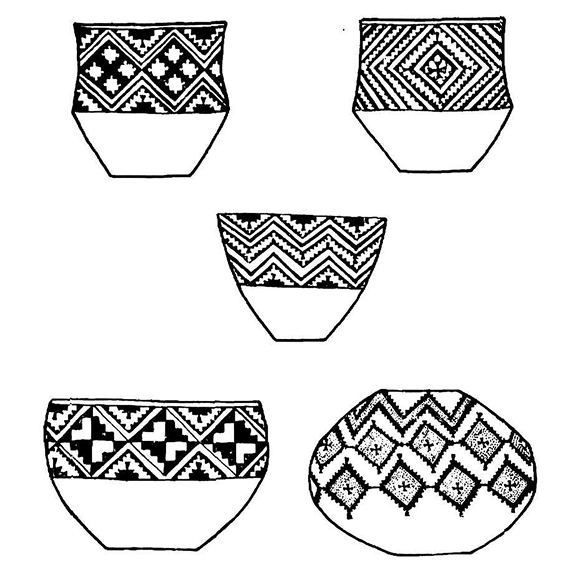
Archaeological discoveries attest to the profound antiquity of carpet weaving on the territory of present-day Turkmenistan, tracing its origins back to the Neolithic era. Excavations in southern Turkmenistan, at the Jeitun settlement, revealed ornamented ceramics whose motifs bear a striking correspondence to those found in traditional Turkmen carpet design. Comparative analysis shows that the visual language of the Jeitun culture (7th–5th millennium BCE) and later carpet ornamentation is essentially identical. In addition, conical spindle whorls were unearthed among the finds—artifacts that affirm weaving as one of the established occupations of the population of the southern foothills of the Kopetdag during the Eneolithic period.
The Pazyryk Carpet
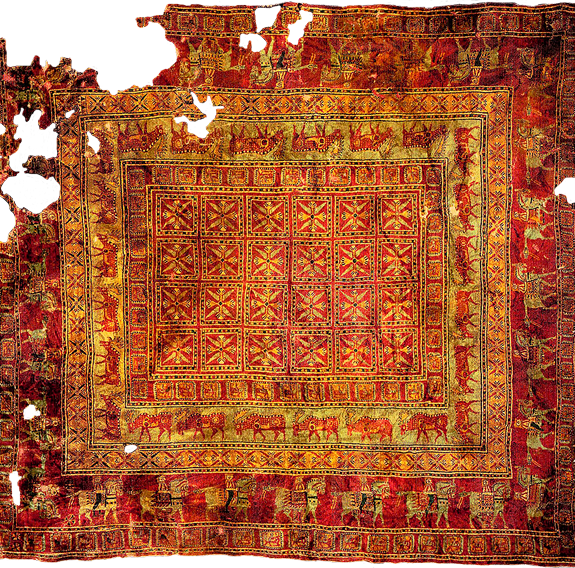
The earliest surviving example of carpet art is widely considered to be the Pazyryk Carpet, discovered in 1949 during the excavation of the Fifth Pazyryk Kurgan by an expedition of the Archaeological Institute of the USSR Academy of Sciences, led by S. I. Rudenko, with the participation of the State Hermitage Museum. Rudenko suggested a possible Central or Near Eastern origin, dating the carpet to the 5th century BCE, while M. P. Gryaznov also noted the likelihood of its production in Central Asia. In 2021, an international research team led by Andreas Späth (Friedrich-Alexander University, Erlangen-Nürnberg, Germany) conducted micro-X-ray fluorescence (µXRF) analysis on the carpet’s dyed fibers. The results, published on 4 March 2021 in Scientific Reports, revealed that the wool had undergone pre-fermentation prior to dyeing, facilitating deep penetration of the pigment into the fiber. The fermentation and dyeing techniques described in the study correspond closely to those historically employed by Turkmen weavers, demonstrating a direct connection between the Pazyryk Carpet and the traditional craftsmanship of Turkmen artisans. The authors also note that the Pazyryk Carpet represents a unique exemplar of the ancient cultural heritage of Central Asia.
The Great Silk Road
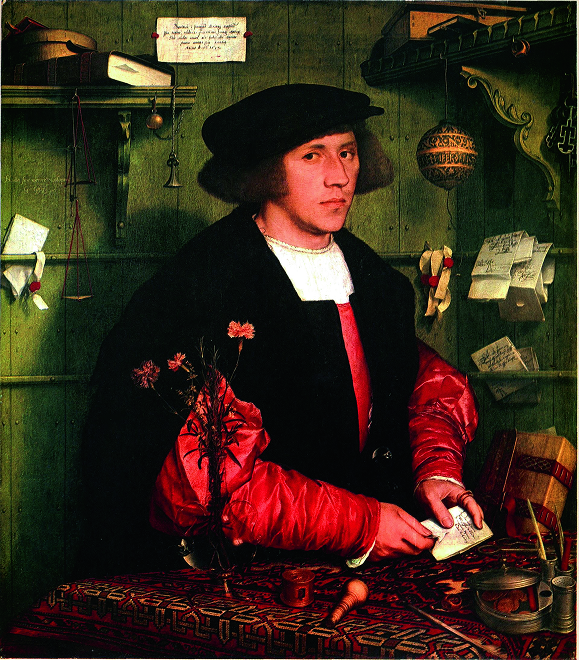
The Great Silk Road was not merely an ancient trade route connecting continents. It was a living space of ideas, discoveries, and cultural exchange, where alongside caravans of silk and spices traveled crafts, technologies, and artistic traditions, forging remarkable connections between civilizations and shaping new ways of understanding the world. Among the most vivid expressions of this heritage are Turkmen carpets—creations born in the tents of nomads, which embarked on their own extraordinary journey across the world. From the caravanserais of the Silk Road to the throne rooms of sultans and the palaces of Renaissance Europe, these carpets have witnessed the flicker of steppe fires, the brilliance of royal courts, the march of warriors, and the inspiration of poets. Across all eras, Turkmen carpets have retained their artistic and spiritual significance, remaining untouched by the tides of history. Their iconography has become a symbol of refined Eastern aesthetics. Turkmen carpets have earned their rightful place in the history of global art, becoming an integral part of the cultural dialogue that began along the Great Silk Road and continues to this day.